
Keyboards · Buying guide
Is the Mechanical Keyboard Too Loud at Night? The Basike 75% Is the Quiet Mechanical (2026)
23:47. Ranked queue is rolling, the house is asleep, and your clicky blue announces every keystroke like a 1952 typewriter. The baby wakes up mid-night. Your partner types in chat: "your mic picks up every click." You max your headset volume to hear the game — and the click still bleeds through. 8 a.m. work call: teammates hear your machine-gun mechanical instead of your voice. And the worst part: the "mechanical = loud" myth pushed you into a membrane board before, and it turned into a mushy key-puddle in three months.
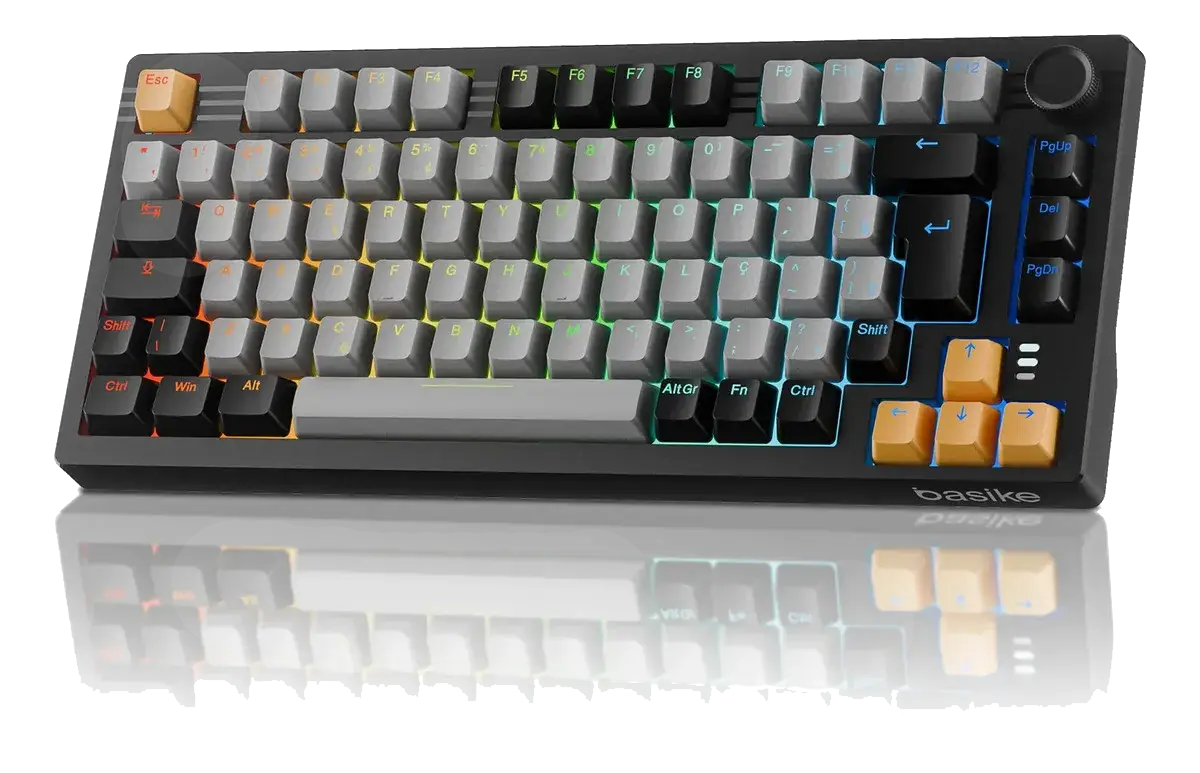
Here's what sellers skip: keyboard noise isn't "gamer soul," it's switch type — and the hierarchy is simple. Clicky is the loudest (an audible click leaf), tactile sits in the middle, and linear is the quietest of the family. The Basike 75% Wireless Mechanical Gaming Keyboard, listed today at R$ 308 on Mercado Livre, ships with factory-lubed Gateron G Pro 3.0 linears — no click leaf, factory lubrication — and verified buyers praise the smooth, quiet typing. This guide covers the ten noise annoyances, what switch type actually changes, and an honest head-to-head against the Redragon Fizz Pro.
Quick Answer
- Noise comes from switch type, not from "being mechanical": clicky > tactile > linear on the volume scale — and the choice is yours, not a sentence.
- The Basike 75% ships factory-lubed Gateron G Pro 3.0 linears: no click leaf, smooth bottom-out, and real buyers praise the "smooth and quiet" typing.
- Not membrane-level silence — and we say so: there is still a mechanical noise floor; the promise is "stop announcing every key," not "library mode."
- Hot-swap is the built-in plan B: one day you can add O-rings or silent switches without buying a new board.
- Vs the Redragon Fizz Pro: both ship stock linears; the noise gap is small — layout and battery decide the buy.
- R$ 308 — below the 90-day average (R$ 314) and the official Basike price (R$ 399.90).
- Verdict: if your keyboard wakes the house, ruins the stream, or embarrasses the call, the problem is the switch — change platforms, not hobbies.
The 10 Annoyances of a Loud Keyboard (and What Fixes Them)
Keyboard noise isn't a detail: it becomes domestic conflict, a mic problem, and buyer's remorse. Below, each annoyance, the real cause, and how the Basike 75% answers it.
| # | Annoyance | Real cause | How the Basike 75% fixes it |
|---|---|---|---|
| 1 | Click clack at 1 a.m. announces every key to the whole house | Clicky blue switch with an audible click leaf | Gateron G Pro 3.0 linear: no click leaf, just bottom-out thock |
| 2 | The live/Discord mic captures every click; chat complains | Click sits right on the voice pattern of a dynamic mic | Lubed linear cuts sharp peaks; less "machine gun" in the VOD and chat |
| 3 | Baby nap or afternoon sleep destroyed by one ranked session | High, repetitive impulse noise | No click leaf: sound drops to a soft spring hum — far less likely to wake |
| 4 | Home office: teammates hear the keyboard louder than the voice | Clicky dominates the mic gate on calls | Clean typing without the click: your voice is the main signal again |
| 5 | The "mechanical = loud" myth pushed you to membrane | One bad experience with a cheap blue switch | A truly quiet mechanical exists — linear is the category you want |
| 6 | Cheap "silent" membrane = mushy keys with no feedback | Low price delivers a puddle, not a switch | Linear has a defined bottom-out: quiet, but with real mechanical return |
| 7 | True "silent" mechanics cost R$ 600+ | Premium silent switches (Gateron Silent, Holy Panda) carry markup | Factory-lubed linear delivers 80% of the quiet at entry price |
| 8 | Hand-lubing switches: hours, mess, risk of ruining them | Home modding without experience | Gateron G Pro 3.0 arrives factory-lubed — zero work, finished result |
| 9 | Plate ping and keycap rattle on cheap boards amplify everything | Loose mount + thin keycaps | Firm build + factory lube cut resonance and ping |
| 10 | Shared room / studio: the hobby has no "mute" mode | People assume the loud switch is the only option | Linear fixes it without giving up mechanics, hot-swap, or RGB |
Why Switch Type Matters More Than "Mechanical"
Clicky (blues and friends) has a click leaf that snaps on purpose: it's the loudest switch in the family, and it carries the "unbearable mechanical" reputation. Tactile (browns and friends) has a bump without the audible click — the middle ground. Linear (reds, pinks, and the Basike's Gateron G Pro 3.0) travels smooth, no bump, no click: it's the quietest, and why gamers who also work from home prefer it.
Beyond the type, factory lubrication cuts internal friction and spring ping — the "sine bell" that turns any key into a bell. The Basike's Gateron G Pro 3.0 arrives lubed: not a mod, the stock state. Practical result per verified buyers: typing that's "smooth and quiet," praised by exactly the people with shared houses.
What to Expect (and Not Expect)
Expect: fewer sharp peaks, no typewriter, cleaner calls, nights that don't end in an argument. Don't expect: absolute membrane silence — a mechanical key always has a bottom-out floor; studio-grade silence usually means O-rings (rubber dampers) or a silent-switch swap via hot-swap, which the Basike supports (3/5-pin). That's the plan B no glued board offers.
Basike 75% vs Redragon Fizz Pro: Which Is Quieter?
Both ship stock linears — honesty first: the noise gap between them is small, and it depends more on your desk and each unit's lube than on the logo. What actually decides the purchase is layout, battery, and extras:
| Feature | Basike 75% | Redragon Fizz Pro |
|---|---|---|
| Price (reference, 2026) | R$ 308 | UPDATE (~R$ 250–320 range) |
| Stock switches | Gateron G Pro 3.0 linear, factory-lubed | Redragon linear (red) switches |
| Typical noise level | Low: no click, no bump, factory lube | Low: linear, no premium factory lube |
| Hot-swap (path to more quiet) | 3/5-pin + pullers in the box | 3/5-pin |
| Layout | ABNT2 75% with physical F1–F12 | ABNT2 60%, F-rows on Fn |
| Battery | 4000mAh | ~1900mAh |
| Media knob | Yes | No |
| If maximum quiet is the goal | Silenter base + hot-swap for O-rings/silent switches | Silenter base; upgrades rely on the same hot-swap |
If quiet is priority one, both kill the clicky problem — and the Basike ships the quietest package of the two (factory lube) with the most complete upgrade path (pullers + 4000mAh + knob). If the priority is the backpack, the Fizz Pro's 60% wins on size.
More usage detail in our full Basike 75% review, and if your pain is also wires, ghosting, and desk space, see the wired-keyboard guide and the ABNT2 layout guide.
Basike 75%: Pros and Cons
Pros
- Gateron G Pro 3.0 linear, factory-lubed — quietest switch in the family
- Verified buyers praise "smooth and quiet" typing
- Hot-swap 3/5-pin with pullers: path to O-rings or silent switches
- No click, no bump: ideal for night, stream, and call
- ABNT2 75%, tri-mode, 4000mAh, knob — quiet didn't cost features
- R$ 308 — below the 90-day average (R$ 314) and official (R$ 399.90)
Cons
- Not absolute membrane silence: a mechanical noise floor remains
- O-rings not included — more quiet means your own upgrade
- RGB at max drains battery faster (the bill is in light, not sound)
- Clicky lovers will miss the audible feedback — swap switches via hot-swap if you want it back
Redragon Fizz Pro: Pros and Cons
Pros
- Stock linear switches — already quieter than clicky
- Hot-swap allows quiet upgrades
- Compact 60% for travel
- Competitive price band
Cons
- No premium factory lube — more spring ping out of the box
- ~1900mAh battery: shorter autonomy
- No media knob
- F-rows on Fn: a pain if you type and game on the same board
When the Redragon Fizz Pro Is Still the Right Call
Honesty before sale. If you already live in Fn layers, backpack size is criterion one, and noise isn't your core problem, the Fizz Pro 60% is more portable — often for a few reais less. If the noise wakes the house, the stream mic catches every click, or the work call becomes a joke, the Basike 75% ships the quietest base with the most complete upgrade path — at R$ 308.
FAQ
Are all mechanical keyboards loud?
No. Noise comes from switch type: clicky (blue) is the loudest, tactile is the middle, linear (red, Gateron G Pro 3.0) is the quietest. The myth was born from cheap clickies — not from mechanical technology itself.
Will the Basike 75% wake a baby?
Much quieter than a clicky: no click leaf, just bottom-out thud and a lubed spring. It isn't membrane silence — if the baby sleeps through background noise (fan, traffic), it will hardly bother; if they need total silence, consider O-rings via hot-swap.
How do I make it even quieter?
Three paths, all supported by the Basike: (1) rubber O-rings on the keycap stems; (2) swap to silent switches (Gateron Silent, Akko Silent) via hot-swap — pullers are in the box; (3) case foam damping, a weekend task for modders. Start with O-rings: cheap and reversible.
Is a linear switch good for gaming?
Yes — it's the favorite for FPS and rhythm games: smooth travel, no bump fighting key-spam, fast recovery. The lubed G Pro 3.0 keeps the consistent feel that matters in long sessions.
Streamer: will the mic still pick up the keyboard?
Less than with clicky — the click's sharp peaks are gone — but any mechanical keyboard has some floor. Mic placement (cardioid, close to the mouth, away from the board) + an OBS noise gate finish the job. The Basike removes most of the "machine gun"; the rest is technique.
Basike 75% or Redragon Fizz Pro for quiet?
Both are linear and both much quieter than clicky. The Basike has factory lube (less spring ping) and ships pullers for upgrades; the Fizz Pro is more compact. For a shared house + stream + calls, the Basike package wins.
Fix the Noise Today
Live prices from trusted sellers on Mercado Livre. Basike 75% Wireless Mechanical Gaming Keyboard with Gateron G Pro 3.0 factory-lubed linears, 82 ABNT2 keys, tri-mode, hot-swap, new, with warranty.
As affiliates, we may earn a commission on purchases made through our links, at no extra cost to you. This never changes our opinion.