
Chargers · USB-C · 67W
MI 67W USB-C Turbo Charger Review: Who Actually Gets 67W?
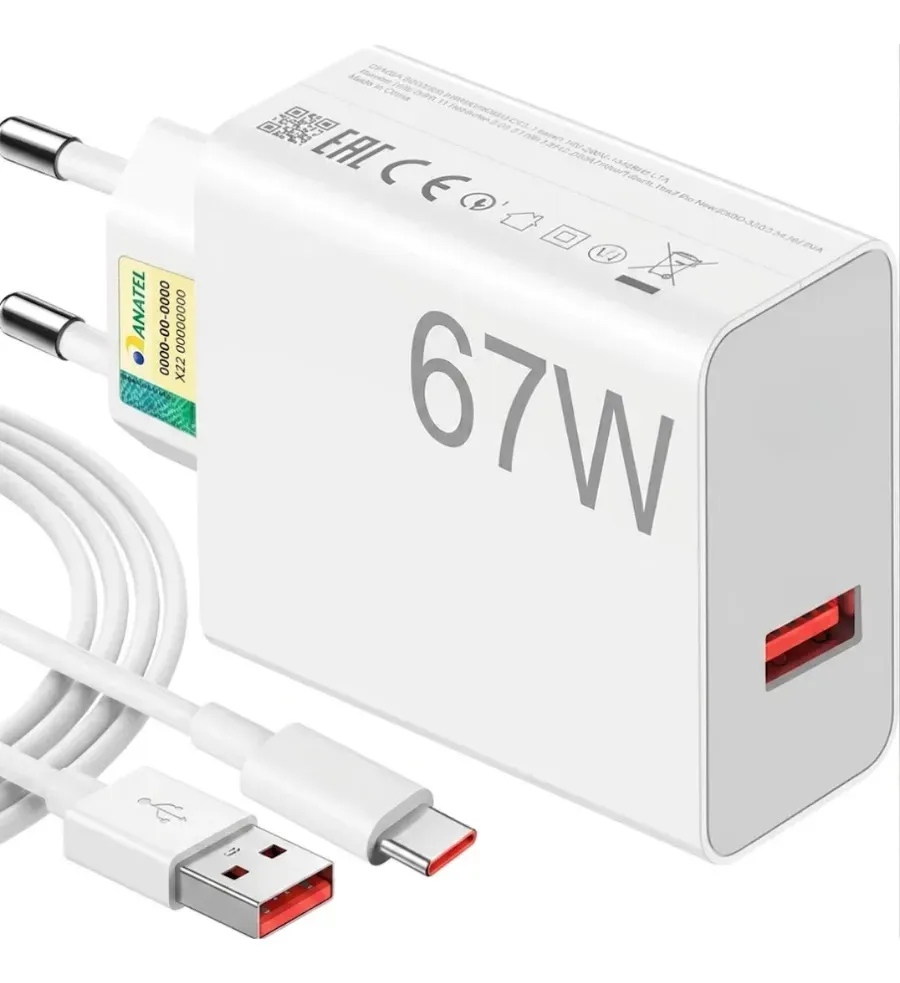
Sixty-seven watts for the price of a coffee is the promise. The reality is more specific: this MI 67W USB-C charger can deliver its full 67W only to a compatible Xiaomi, Redmi or POCO phone using a high-current cable. An iPhone will not see 67W. A Samsung will not see 67W. A MacBook Air will not see 67W. They see USB Power Delivery, usually between 20W and 65W, depending on the device and the cable. That is still useful, but it is not the headline.
At R$ 19,86 this is a budget listing, and the buyer reports reflect that. Many units charge quickly and feel well finished; others fail to trigger turbo, run hot or arrive with a cable that gives up early. The charger is worth it if you own a compatible Xiaomi phone and treat the cable as a consumable. It is a gamble if you expect universal 67W from every device.
Quick answer
- Full 67W is conditional. It needs a compatible Xiaomi/Redmi/POCO phone, the correct 6A cable and a battery that is not too hot or too cold.
- The cable is part of the circuit. A generic 3A cable can drop the phone to 10-18W or block the turbo handshake completely.
- iPhone 15/16/17 USB-C: yes, it charges, but at normal USB-PD speed, around 20-27W, not 67W.
- Laptops: up to 65W PD if they charge over USB-C and the cable is e-marked. Gaming laptops that demand 100W+ will complain.
- Safety: a good unit negotiates power and gets warm. A bad unit runs scalding hot, smells of plastic or sparks. Stop using that one.
- Buying tip: at this price, check the model code, the orange USB insert and the 5th pin before believing an "original MI" claim.
MI 67W USB-C vs typical chargers
| Feature | MI 67W USB-C | Typical 20W phone charger | 65W USB-C laptop charger |
|---|---|---|---|
| Maximum power | 67W Xiaomi proprietary / 65W USB-PD | 20W | 65W USB-PD |
| Port | USB-C | USB-A or USB-C | USB-C |
| Input | 100-240V, 50/60Hz | 100-240V | 100-240V |
| Key outputs | 5V3A, 9V3A, 11V6.1A, 12V3A, 15V3A, 20V3.25A | 5V3A, 9V2.22A | 5-20V PD |
| Cable in the box | USB-C to USB-C (must be 6A for full speed) | Usually none | Usually none |
| Protocols | Mi Turbo Charge, PD 3.0, QC (PPS not stated) | PD / QC | PD 3.0 |
| Best for | Xiaomi phones, tablets and USB-C laptops | iPhone and Samsung phones | MacBook and ultrabooks |
| Street price | Around R$ 20 in this listing | R$ 30-60 | R$ 100+ |
What 67W actually means
Power is voltage multiplied by current. The 67W figure comes from Xiaomi's 11V/6.1A fast-charge mode, which is a proprietary handshake. Under the open USB Power Delivery standard, the same charger tops out at 20V/3.25A, or 65W. The difference sounds small, but it explains why a 67W charger shows 65W on a laptop and 67W only on a supported Xiaomi phone.
This is not false advertising; it is how fast-charge ecosystems work. The problem is the marketplace listing, which often shows "67W" in large letters and hides the conditions in small print. If your phone does not speak the Xiaomi protocol, the charger falls back to a standard PD profile and the phone decides how much it accepts.
The cable decides whether you get turbo
A 67W charger without a 6A cable is like a sports car with a speed limiter. Xiaomi's own support pages say the original high-current cable is required for maximum output, and independent teardowns show why: the cable carries an e-marker chip and, on Xiaomi's USB-A designs, a fifth pin for the turbo handshake. A generic 3A cable will still charge, but it can cap the phone at 10-18W or stop the "67W Max" animation from appearing.
The bundled Type-C cable is therefore the first thing to test. Plug in a compatible phone, check that the lock screen shows Mi Turbo Charge with decimals, and compare the time to charge with the cable and with a known good 6A cable. If the bundled cable is flimsy, replace it before blaming the charger.
Real speeds by device
On a Xiaomi phone that supports 67W, expect roughly 50 minutes from 0 to 100%, depending on the model and battery temperature. A Xiaomi phone limited to 33W will stay at 33W; the charger does not force extra power into it.
On an iPhone 15, 16 or 17 with USB-C, the charger behaves like a normal USB-PD brick: about 20-27W, enough for roughly 50% in half an hour. On a Samsung Galaxy, expect around 25W unless the specific unit supports PPS, in which case compatible models can reach 45W. Pixel phones usually settle around 18-27W.
On a USB-C laptop, the charger can supply up to 65W, which is fine for a MacBook Air, an ultrabook or a tablet. It is not enough for a gaming laptop that ships with a 180W or 230W adapter. Accessories such as earbuds, watches and power banks draw only a few watts and charge normally.
What buyers actually report
Across marketplace reviews, the pattern is consistent. Buyers praise the finish, the compact size and genuinely fast charging when the phone, cable and unit all cooperate. Negative reports cluster around three issues: the charger fails to trigger turbo on some phones, the bundled cable stops working or limits speed, and the plastic feels lighter and less durable than expected. A few units also run hotter than comfortable.
That does not prove every unit is bad, but it does mean this listing is a lottery rather than a guaranteed original. Buy from a seller who shows the model code and accepts returns, test turbo in the first days with a compatible phone and a known 6A cable, and use the marketplace return window as your real warranty.
The 67W Max animation, explained
Xiaomi phones show a charging animation when the handshake succeeds. The "67W Max" label with decimal battery percentage is the phone confirming that charger, cable and device agreed on the fast profile. If you only see "Charging" or a generic quick-charge message, something in the chain is limiting the speed.
Check the obvious causes in order: the phone model must support 67W, the cable must be the original or a certified 6A cable, the USB-C port must be clean and free of lint, and the battery must be within a normal temperature range. A software update or a dirty port can also block the animation.
Build quality, heat and safety
Genuine MI chargers use flame-retardant plastic and include over-voltage, over-current, over-temperature and short-circuit protection. They still get warm under full load; that is normal. What is not normal is a case that is too hot to touch, a burning smell, visible scorch marks or sparks when you plug it in. Those are signs of a poor unit, and the only correct action is to stop using it.
At this price point you are buying from a marketplace listing, not a Xiaomi store. Check the model code printed on the charger, the weight (a genuine 67W unit is roughly 100g, not 50g), the orange plastic inside the port and, on USB-A versions, the fifth pin. A seller who cannot show those details is a risk, no matter how good the photos look.
Main characteristics
- 67W maximum output in Xiaomi's proprietary 11V/6.1A mode, with 65W USB-PD for other USB-C devices.
- Single USB-C port on this USB-C version, plus a USB-C to USB-C cable in the box.
- Wide 100-240V input, so it works on 110V and 220V outlets without a transformer.
- Multiple protection layers: over-voltage, over-current, over-temperature and short-circuit protection on genuine units.
- Compact white body that fits a bag pocket and looks clean on a desk.
- Backward compatible with slower phones: the device only pulls the power it supports.
Pros and cons
Pros
- Very low price for a 67W-capable charger with a cable included
- Full 67W on compatible Xiaomi, Redmi and POCO phones
- 65W USB-PD is enough for most ultrabooks and tablets
- Works on 110V and 220V
- Compact, light and easy to carry
- Good value as a spare charger for a Xiaomi household
Cons
- 67W is not universal; iPhone, Samsung and Pixel users see far less
- The bundled cable quality is inconsistent and can block turbo
- Runs warm under sustained full load
- Only one port, so it cannot charge a phone and a laptop at full speed together
- Marketplace listings mix original, compatible and counterfeit units
- Warranty and after-sales support depend entirely on the seller
Frequently asked questions
Does this charger fast-charge an iPhone?
It charges an iPhone 15, 16 or 17 with USB-C at normal USB-PD speed, around 20-27W. That is enough for about 50% in 30 minutes, but it is not 67W. Older Lightning iPhones need a USB-C to Lightning cable, which is not included.
Will it charge a Samsung Galaxy at 45W?
Only if the exact unit supports PPS and the phone supports 45W PPS. Many budget units do not implement PPS, and then the Galaxy settles around 25W. Check the model specs before buying for a Samsung phone.
Can I use any USB-C cable?
You can charge, but you may not get full speed. For 67W you need a 6A cable, and for Mi Turbo Charge on Xiaomi USB-A chargers you need the fifth pin. A generic 3A cable often limits the phone to 10-18W.
Does it charge a laptop?
Yes, up to 65W over USB-PD if the laptop charges through USB-C and the cable is e-marked. It is fine for a MacBook Air or an ultrabook, but not for a gaming laptop that needs 100W or more.
Is 67W safe for my phone battery?
Yes. The phone requests the voltage and current it supports, and a genuine charger negotiates before delivering power. Heat is normal; a scalding case, plastic smell or sparks are not. Stop using the charger if you notice those signs.
Why does my Xiaomi not show the 67W Max animation?
The phone may not support 67W, the cable may not be a 6A Xiaomi cable, the USB-C port may be dirty, or the battery may be too hot or too cold. Test with the original cable and a cool phone first.
Is this an original MI charger?
That depends on the seller. Genuine units have a crisp model code, weigh around 100g, use an orange insert in the port and, on USB-A versions, show a fifth pin. If the price is far below a Xiaomi store and the seller cannot prove the model, assume it is a compatible unit.
Can I leave it plugged into the wall?
A good charger draws very little power when idle. Still, unplug it during storms or long trips, and keep it away from water and flammable surfaces. No charger should be used with a damaged cable or a cracked case.
Check today’s price
Live pricing from Mercado Livre. Confirm the model, the cable type and the seller warranty before you buy.
Check today’s price View on Mercado LivreAs an affiliate, we may earn a commission when you buy through our links, at no extra cost to you. It never changes our opinion.